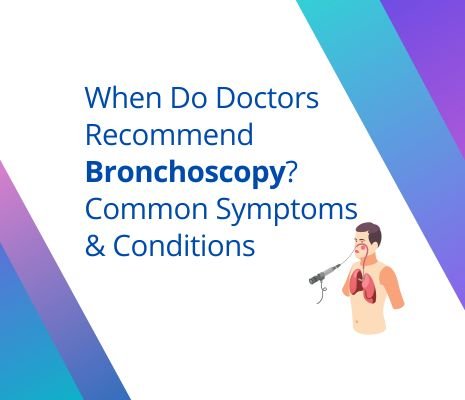
Bronchoscopy is one of the most important diagnostic and therapeutic tools used in modern chest medicine. For patients with unexplained breathing issues, persistent symptoms, or abnormal scans, a bronchoscopy allows doctors to directly examine the airways, collect samples, and even perform certain treatments — all in a minimally invasive way.
But when exactly do doctors recommend a bronchoscopy? Here are the most common symptoms and conditions where this procedure becomes essential.
1. Persistent Cough That Doesn’t Improve
If a cough lasts more than 3–4 weeks despite medication, a bronchoscopy helps check for:
- Hidden infections
- Allergies
- Airway inflammation
- Tumors or growths
- Foreign bodies (especially in children)
When standard tests don’t explain the cause, bronchoscopy gives a clear view inside the lungs.
2. Unexplained Breathlessness
Shortness of breath without a clear diagnosis may point to deeper airway issues. Bronchoscopy helps detect:
- Airway narrowing
- Secretions blocking the bronchi
- Early lung cancer
- Interstitial or diffuse lung diseases
It helps determine the exact cause so the right treatment can begin.
3. Abnormal Chest X-Ray or CT Scan
If your imaging shows suspicious findings, a bronchoscopy is often the next step. It helps evaluate:
- Lung nodules
- Masses
- Collapsed lung segments
- Unresolved pneumonia
- Cavities or shadows
Doctors use bronchoscopy to take biopsies or washings from the abnormal area for accurate diagnosis.
4. Coughing Up Blood (Hemoptysis)
Even a small amount of blood in sputum needs attention. Bronchoscopy helps:
- Identify the bleeding source
- Detect infections, tumors, or injuries
- Plan appropriate treatment quickly
In severe cases, bronchoscopy can also help control bleeding.
5. Recurrent or Non-Resolving Pneumonia
If pneumonia keeps coming back or does not improve with antibiotics, bronchoscopy helps check for:
- Blocked airways
- Resistant infections
- Fungal or atypical infections
- Tumors obstructing airflow
Timely bronchoscopy helps prevent complications.
6. Suspected Tuberculosis or Drug-Resistant TB
Bronchoscopy is very useful when:
- Sputum tests are negative
- Patients cannot produce sputum
- TB affects deeper or less accessible lung areas
It provides accurate samples for diagnosing TB or drug resistance.
7. Lung Cancer Diagnosis & Staging
Bronchoscopy allows pulmonologists to:
- Inspect abnormal growths
- Take biopsies
- Collect lymph node samples
- Determine the stage of cancer
- Plan treatment with precision
Advanced techniques like EBUS (Endobronchial Ultrasound) further improve accuracy.
8. Foreign Body Removal
Common in children but also seen in adults, bronchoscopy can remove:
- Food particles
- Nuts or seeds
- Plastic objects
- Pencil caps, beads, etc.
It is a safe and effective way to clear the airway.
9. Chronic Infections & Interstitial Lung Disease (ILD) Evaluation
Bronchoscopy helps assess:
- Rare infections
- Fungal diseases
- ILD patterns
- Autoimmune-related lung involvement
It provides essential information when other tests are inconclusive.
Bronchoscopy is recommended when symptoms are persistent, imaging findings are unclear, or when doctors need precise information from inside the lungs. It plays a crucial role in diagnosing infections, cancers, airway diseases, and unexplained respiratory issues.
If you or someone you know is experiencing chronic respiratory symptoms in Pune, early evaluation by a pulmonologist can make a significant difference. A timely bronchoscopy in Pune—when required—leads to faster diagnosis and better recovery.

